
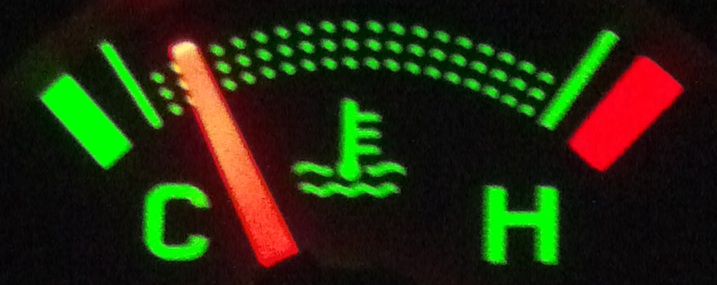
If oil is to the car what blood is to the human body, then the engine is the heart, and an engine seizure the equivalent of a heart attack. Luckily for your car, potential engine seizures are easier to detect than potential heart attacks. Here, I will describe a simple method you can follow to to monitor the health of your car’s engine. It involves keeping a tab on the temperature gauge, and is a technique I have used often in the past to save many engines. Indeed, this principle applies even to racing cars.
- When you start your car for the first time in the day, observe the temperature gauge. It should be at the minimum level.
- After driving for 5-10 minutes, check the gauge again. It should now be at the halfway point. If the design of your gauge shows numbers, it should be at 80 degrees Celsius. Whatever it is, remember this point on the gauge. It differs from car to car.
- After reaching this point, the gauge must remain constant throughout the journey, whether you travel 10km or 1000km.
If at any time the gauge goes beyond the constant point you have been observing everyday (even by 1 mm), it is a signal that there is a problem with the engine. Do not think the gauge has to cross the red line before you should get worried. The problem could be:
- Driving without coolant.
- Malfunctioning thermostat.
- Defective water pump.
- Clogged radiator.
- Defective radiator fan.
- Defective radiator cap.
Due to any of the above problems, the engine will slowly start to overheat. So, if you notice at any time that the gauge has crossed the normal point, you should take the car to the workshop as soon as possible. If not near a workshop, turn the AC off. Most newer cars automatically shut off the AC when the temperature is above normal. This is another symptom of overheating. In fact, because of this, many drivers bring the car to the workshop thinking it has an AC problem, when it is actually an engine problem.
After turning the AC off, drive towards the workshop slowly, never letting the gauge reach the red line. If it does, stop the car and let the engine cool for a while before driving again. In this situation, it is better to have the vehicle towed. Never drive the car when the temperature gauge is at the red line. If you do, you are literally killing the engine.
A major engine seizure can set you back by several lakhs. Thankfully, it is not difficult to detect the early warning signs of a malfunctioning engine. Just remember to keep an eye on the temperature gauge. Despite how important the gauge is, some cars do not have it. I would not consider buying such cars.
 Thirmal Roy on Automobiles
Pingback: Chevrolet Captiva: Engine Overheating Problem | Thirmal Roy on Automobiles
In my experience even with temperature gauges one has to be careful. In my case the coolant drained out because of a leak at the neck of the radiator. However the temperature gauge also seemed to have a problem (probably the problem had been there for some time) because the needle never went above the normal spot.
Is there a way to calibrate the temperature gauge?
However I did ignore the other symptom that you mention – the AC getting cut off. Expensive mistake!
Wish I had read your post earlier.